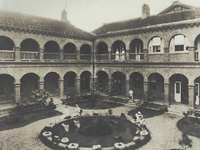
 Hobe MacKay Clinic
After Dr. George Leslie MacKay passed away, the Hobe MacKay Clinic was forced to suspend operations for five years.
In 1906, Dr. Jacobus Decker resumed MacKay’s medical work, reopening the Hobe MacKay Clinic. In 1912, the clinic was relocated from Tamsui to its current site on Zhongshan North Road and officially named MacKay Memorial Hospital.
From the original Hobe MacKay Clinic to today, MacKay Memorial Hospital has survived three different political regimes, enduring wars, institutional transitions, and even moments of near‑collapse. Yet it still stands firm today. Those who know its history regard this as a miracle. But in truth, it is not accidental—looking back over the past century, MacKay workers have faithfully partnered with God. Many courageous and moving stories of saving lives took place, such as:
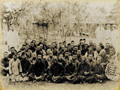 Lo‑Shan Leprosy Hospital
In 1924, Dr. James Irvine began receiving leprosy patients from all over Taiwan.
In 1924, Dr. Irvine began caring for leprosy patients nationwide.
On April 30, 1934, the Lo‑Shan Leprosy Hospital was opened to provide proper care. During the initial attempt to establish a facility in Bali, Dr. Irvine faced local hostility and threats, even being forced to hide in the mountains for a time. A foreign doctor willingly risking his life for strangers—this was purely the power of faith.
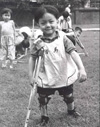 Polio patient
In 1966, the Polio Rehabilitation Center was established.
In 1968, one million NT dollars were raised to care for children with polio and cleft lip.
Besides caring for leprosy patients, the hospital also pioneered Taiwan’s first Polio Rehabilitation Center, Counseling Center, ICU, cleft‑lip surgery services, and burn wards. What made these services precious was not that they were “the first in Taiwan,” but that they required tremendous manpower and resources at a time when Taiwan had no labor insurance, no national health insurance, and limited economic strength.
This compassion for patients—serving without conditions—unexpectedly saved the hospital itself.
Crisis as Turning Point — The Continuation of the MacKay Spirit
Between 1975 and 1980, MacKay faced severe operational crisis. During the Fuyuan Street explosion, the injured suffered extreme trauma. Many hospitals refused to admit them. MacKay Memorial Hospital, however, did everything to save them. Some family members knelt upon arrival at the ER—they had already been turned away by multiple hospitals. Because MacKay respected life and cared for those in suffering, the public deeply affirmed the hospital, bringing crucial support during difficult times.
In 1982, during the Neihu Futian coal mine disaster, gas leaks prevented rescuers from entering. Hospital staff rushed to the site, descended 1,180 meters underground, and searched in darkness to save the trapped miners.
History reveals an important truth: God’s saving work is accomplished through countless unnamed heroes who quietly dedicate themselves. Although individuals may be small and fragile like thorny bushes, because of God’s presence, those who respond to His calling can accomplish immeasurable value. God honors generations of silent laborers—whether Christian or not—and completes great missions through them.
God constantly hears, sees, and knows the needs of the people. His salvation is fulfilled through countless unseen heroes. Even though our abilities are small and limited, like thornbushes, God’s presence allows those who commit themselves to achieve infinite worth. God treasures these humble workers throughout history. Through their efforts, great history and great missions are accomplished, and God’s love and redemption are revealed.